
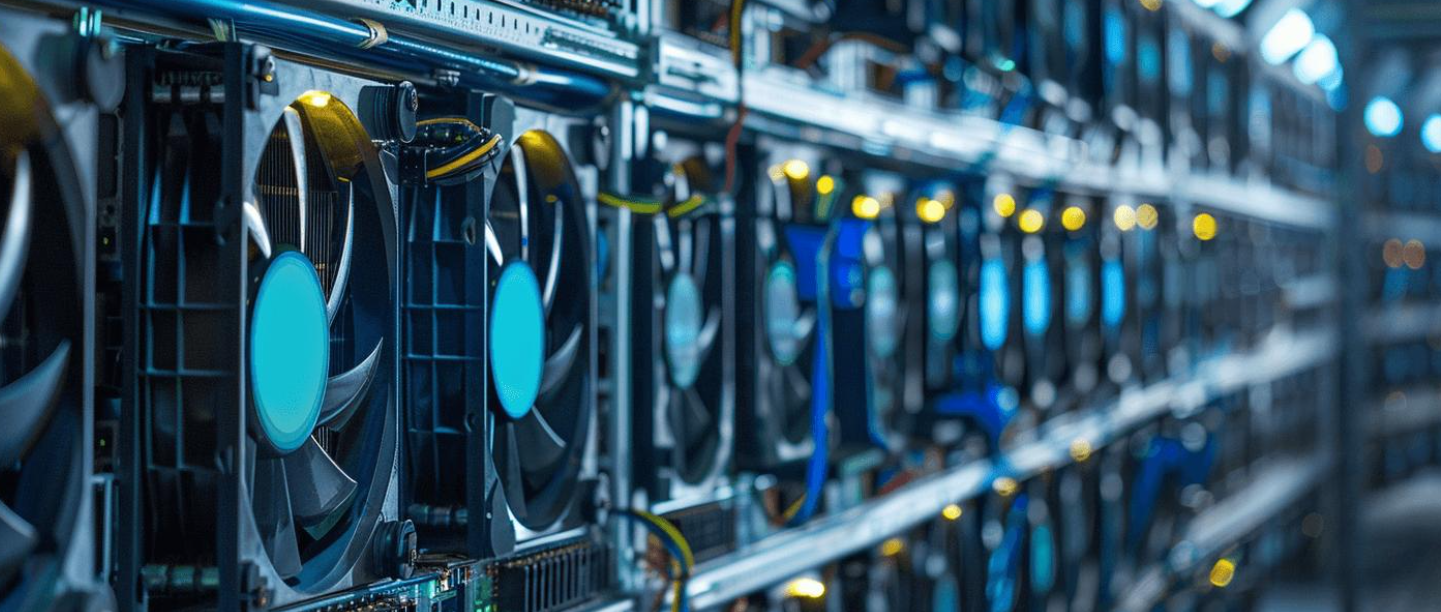
Bitcoin mining sounds like digging for digital treasure. But no pickaxes are involved—and no one is uncovering coins buried on the internet.
Mining is how Bitcoin's network adds new blocks of transactions to its shared history. Specialized computers compete to solve a mathematical challenge, and the winner may earn a reward for producing a valid block.
1. What is Bitcoin mining?
When people send Bitcoin, their transactions are broadcast to the network. Nodes check whether transactions follow Bitcoin's rules. Miners select eligible transactions, assemble them into a candidate block, and compete to find a valid proof of work for that block.
Think of it as proposing the next page in a shared record book. The miner does the computational work to propose a page, but other network participants independently verify that it follows the rules.
2. Proof of work: the digital puzzle
Bitcoin miners repeatedly calculate cryptographic hashes—short digital fingerprints of block-header data—while changing a value called a nonce and, when needed, other block data.
Each attempt produces a hash that is unpredictable in advance. To qualify, the hash must be below the network's current target. Miners therefore make enormous numbers of attempts, searching for a result that meets the target.
Press the button to test batches of sample nonces. A real Bitcoin miner performs SHA-256 calculations at vastly greater speeds.
The key lesson: finding a qualifying hash requires trial and error, but checking a proposed solution is comparatively easy.
Dig Deeper: What is a nonce?
A nonce is a number miners can change in the block header to produce different hashes. Since the nonce field is limited, miners also modify other candidate-block data to continue searching. Each different candidate gives them another chance to find a hash below the target.
3. What happens when someone finds a block?
A miner who finds a qualifying hash broadcasts the candidate block. Other nodes check its proof of work, transactions, and other consensus rules. If valid, they can add it to their view of the blockchain and relay it onward.
Bitcoin aims for an average of about 10 minutes per block across the entire network—not every 10 minutes for each miner. Actual intervals vary because mining is probabilistic.
Sometimes two miners find competing valid blocks close together. The network eventually converges on the chain with the most accumulated proof of work, and a previously accepted block can become stale. That's one reason additional confirmations matter.
4. Hashrate and mining difficulty
Hashrate measures how many hash attempts a miner can make per second. Higher hashrate generally means more chances to find a qualifying hash, but it also typically means more equipment and electricity.
1 PH/s = 1,000 TH/s · 1 EH/s = 1,000 PH/s
Bitcoin also adjusts its mining difficulty approximately every 2,016 blocks, aiming to keep the average block interval near 10 minutes as total network computing power changes.
Slide to change an example miner's hashrate. The bar shows its share relative to an illustrative 1 EH/s reference, not the live Bitcoin network.
100 TH/s is 0.01% of 1 EH/s.
This is a unit comparison only. It does not calculate block odds, mining revenue, or the current network hashrate.Dig Deeper: Why does difficulty change?
If the network has more total hashing power, blocks would tend to arrive faster without adjustment. Bitcoin periodically adjusts the target so that valid hashes become harder or easier to find. This helps maintain the long-run block schedule, though individual block times remain unpredictable.
5. What do miners earn?
When a miner produces a valid block that remains in the accepted chain, the block's coinbase transaction can award the miner newly created Bitcoin (the block subsidy) plus the transaction fees from included transactions.
Newly created coinbase outputs cannot be spent until they have matured through 100 additional blocks on top of the block containing them. This is commonly called the 100-confirmation maturity rule.
Important: Most individual miners will never find a block on their own. Even a powerful miner may run for a long time without finding one. Rewards are probabilistic, equipment and energy cost money, and mining can result in a financial loss.
Dig Deeper: Why wait for coinbase maturity?
Bitcoin requires coinbase outputs to mature before spending because a block can be displaced by a competing chain. The waiting period reduces complications from newly created coins in blocks that later become stale.
6. Can anyone mine Bitcoin?
Anyone can participate in Bitcoin mining, but competitive mining today generally uses specialized computers called ASICs (application-specific integrated circuits). These machines are designed to calculate Bitcoin hashes efficiently.
Some people operate small home miners to learn, experiment, or support the network. Larger operations run many machines and manage substantial power and cooling needs. Either way, electricity cost, hardware reliability, noise, heat, and network difficulty all matter.
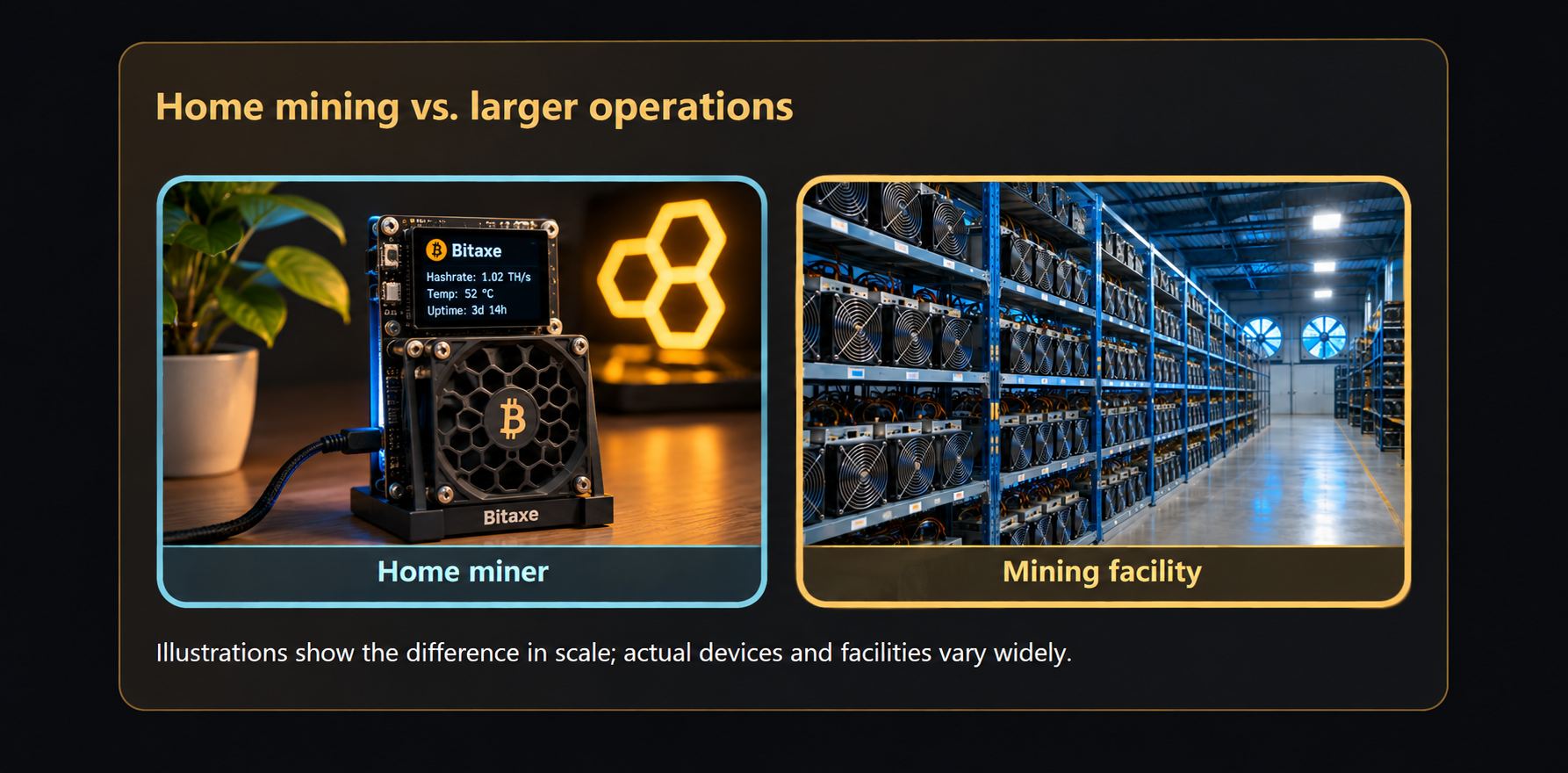 Illustrative images showing the difference in scale; actual devices and facilities vary widely.
We'll explore solo mining versus pool mining in Chapter 4. Those approaches change how miners pursue and share rewards, but neither eliminates mining costs or guarantees a profit.
Let's see what you've learned!
No grades or accounts—just three questions to reinforce the big ideas.
Two different ways to participate in mining—and why the difference matters. Continue to Chapter 4 →
Questions about any of these concepts? You're welcome to get in touch. These lessons are free and require no membership.