
In Chapter 3, we learned that Bitcoin miners compete to produce valid blocks. But miners don't all participate in the same way.
Some mine independently, hoping to find a block themselves. Others join forces through mining pools, earning smaller payments when the pool succeeds. Neither approach guarantees a profit—and understanding the difference helps you make informed choices.
1. What is solo mining?
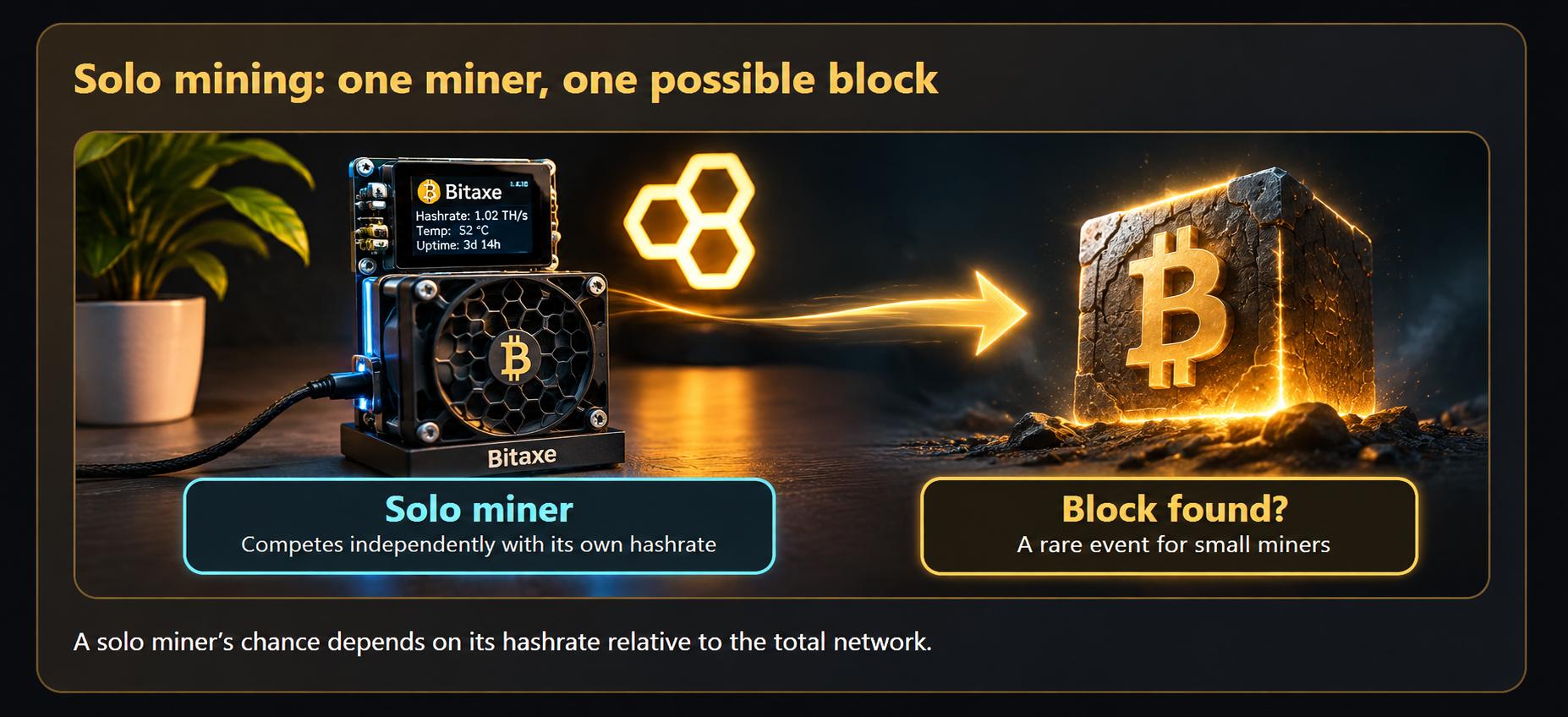
With solo mining, a miner tries to find a valid Bitcoin block independently. If their block is accepted and remains in the chain, they can receive the block subsidy and transaction fees, subject to their setup and any service arrangements.
The trade-off is uncertainty. A small miner has a very small fraction of the network's total hashrate, so it may run for years without finding a block—or get extraordinarily lucky.
Dig Deeper: Does solo mining mean mining completely alone?
Not necessarily. A solo miner may use software, a hosting provider, or a solo-mining service to connect equipment and submit work. What matters is the reward arrangement: the miner is not sharing ordinary block rewards proportionally with a pool of participants. Always review service terms and fees.
2. What is pool mining?
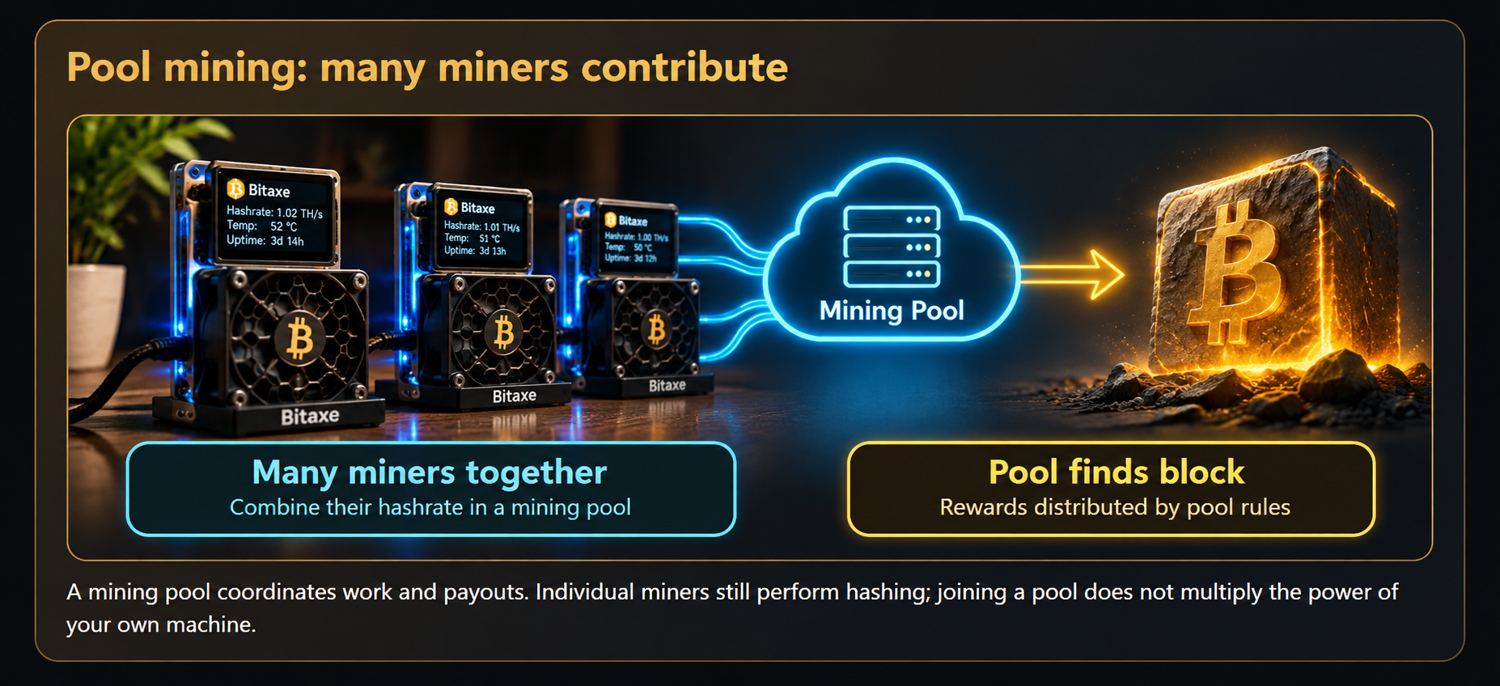
In pool mining, many miners contribute computing power to a coordinated mining operation. When the pool finds blocks, participating miners may receive payouts according to the pool's rules and their contributed work.
Pool mining generally means smaller, more frequent payouts than solo mining at the same hashrate, but the exact frequency, amount, minimum payout threshold, and fees vary by pool.
Dig Deeper: What are shares?
Mining pools commonly assign easier proof-of-work targets so they can measure each participant's contributed work. A result meeting that easier target is called a share. Shares are accounting evidence for the pool—not Bitcoin blocks and not guaranteed rewards. Only a hash satisfying Bitcoin's much harder network target can create a valid block.
3. Solo vs. pool: what's different?
Neither option creates extra Bitcoin or changes the network's total rewards. Pooling primarily changes how block-discovery uncertainty is shared.
4. Why Solo Mining Takes Luck
Every mining attempt is another chance to find a qualifying result. More hashrate means more attempts, but finding a block is still unpredictable.
Imagine each square is one independent attempt. For this simple example, each attempt has a 1% chance of success. Real Bitcoin block odds for a typical home miner are far smaller.
Press the button to see how many blocks you find. Sometimes you will find none!
Mining is about probability, not promises. Even with a 1% chance per attempt, trying 100 times does not guarantee one success.
Educational probability demonstration only. Squares are not real Bitcoin hashes, blocks, or mining earnings.Joining a mining pool does not make your own machine luckier. Instead, participants share in the pool’s successes according to its payout rules.
5. How do pools decide what to pay?
Mining pools use different payout models. You may see terms such as PPS (pay per share), FPPS (full pay per share), or PPLNS (pay per last N shares).
Eligible shares earn a set payment based on the pool's model, even if the pool hasn't just found a block. The operator takes on more short-term variance.
Similar to PPS, with an estimated transaction-fee component included according to the operator's formula.
Payouts depend on the shares counted in a recent work window when the pool finds blocks. Timing and amounts can fluctuate.
It's also worth checking who controls the block template, where payouts are sent, and whether the operator can change terms. A pool's convenience comes with some dependence on its operator.
6. Which approach makes sense?
There's no universal answer. Someone running a small home miner for learning or the excitement of a rare solo block might prefer solo mining. Someone seeking more regular, smaller payouts might prefer a pool.
Consider electricity costs, equipment, heat and noise, pool or service fees, payout rules, and your tolerance for long stretches without rewards. Mining can lose money under either approach.
Solo: You pursue an uncertain block reward independently.
Pool: You contribute work and participate in a pool's reward distribution.
Neither guarantees Bitcoin or a financial return.
Let's see what you've learned!
Three quick questions. No account, no grade, no pressure.
How Bitcoin wallets work, how to protect your keys, and what to watch out for. Continue to Chapter 5 →
Have a question? You're welcome to reach out. The Learning Hive is free, with no membership required.